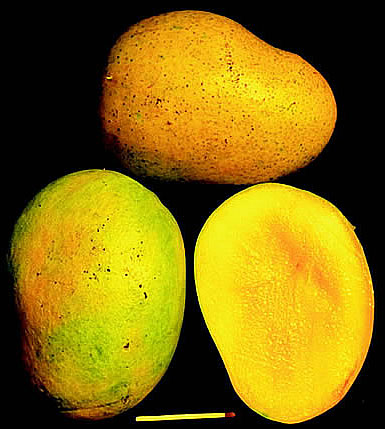
This cultivar variety, type also originated from a chance seedling found at the Kenya coast. The tree is grown extensively in the Malindi area.
The fruit is large and oblong longer than broad but not as slender as Ngowe. The shoulders are only slightly curved, and the beak a pointed projection at the tip of a fruit is obscure. The average fruit dimensions are: 11.5 cm long by 7.8 cm broad with a weight range of 430–640 g (mean: 511 g). The fruits are pale olive green with bloom the delicate waxy or powdery substance on the surface of berries and yellow-apricot when ripe. The internal fruit quality is good to excellent; the flesh is of a deep orange colour, virtually free from fibre, juicy, and of a very strong typical mango flavour. Propagation by seed is possible.
The tree is large and vigorous, and the picking season covers the months of January to February. There is no alternate bearing and the yields are medium to heavy.
Advantages:
seed propagation possible (polyembryonic mode for reproduction: contains more than one embryo; produces true-to-type progeny)
regular bearing
fairly anthracnose resistant
Disadvantages:
susceptible not resistant to powdery mildew
flavour not liked by everybody
tree size